07. Data in Mobile
Data in Mobile
Before we take a look at how all this data is exactly used by advertisers, there is one more important development to consider. Data in the form of cookies is unique to the browser environment, so it relates to all the content a user accesses through the browser. That can either be on a desktop or on a mobile device.
However, there is an increasing amount of online content consumption that happens on mobile platforms outside the browser, but in mobile applications or apps. So, if cookies don’t work for apps, how do publishers keep track of behavior on the apps?
Tracking using Advertising IDs
The different mobile operating systems have a special way for advertisers to track information through the device ID for advertisers. It is a unique code per device that holds information advertisers can use to understand a user’s behavior.
In iOS, the operating system for Apple devices, this is referred to as IDFA (ID for advertisers) and in Google’s Android it is the Android Advertiser ID.
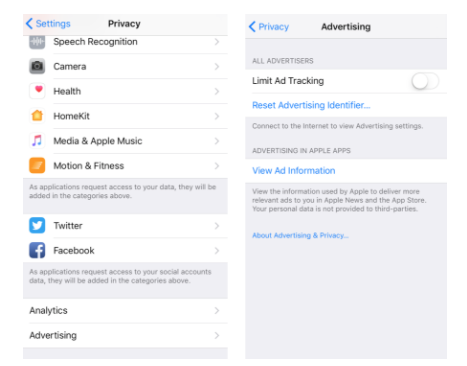
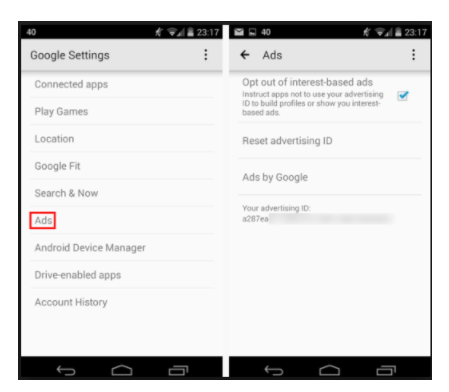
You can actually check out the information in the IDs yourself to see what is stored there. Users can also ‘reset’ the ID, which is comparable to ‘clearing cookies’ - making the system forget what was stored.
Here is where you can find them:
In iOS
You can find info on the ID for Advertisers in the privacy settings
In Android
You can find info on the Advertising ID in the Google Settings
Challenges connecting behavior across platforms
Having a different standard in the browser (the cookie) and on the mobile platforms (the ID) poses its own challenges as it makes it very difficult for publishers to track behavior across platforms.
For instance, if James is reading the New York times on his laptop and then later reads some more on his mobile phone, the NYtimes does not automatically recognize James as the same person on those two platforms and thus it does not really know that the behavior is connected.
Since all publishers see a lot more of their traffic go through mobile platforms, they all work hard to try to get users to log in when consuming their content on mobile apps.
Once a user logs in, the publisher has a new way to connect all the dots through the log-in ID.
Right now, both Google and Facebook are very strong at using their login ID to connect behavior across platforms. Since users use products of their platforms that require login, like messenger and email on mobile phone and desktop, Google and Facebook can more easily connect behavior on mobile with behavior on the desktop than other publishers can.